
Getting started
The cartoon in this lesson is more than 270 years old. It was published in a newspaper in Philadelphia in 1754, and it is one of the most famous political cartoons in American history. At first sight it looks strange: a snake cut into pieces, some letters and three words. Without knowing the historical context, it is hard to understand. That is typical of political cartoons: they comment on a specific situation, and you need some background knowledge to work out the message.
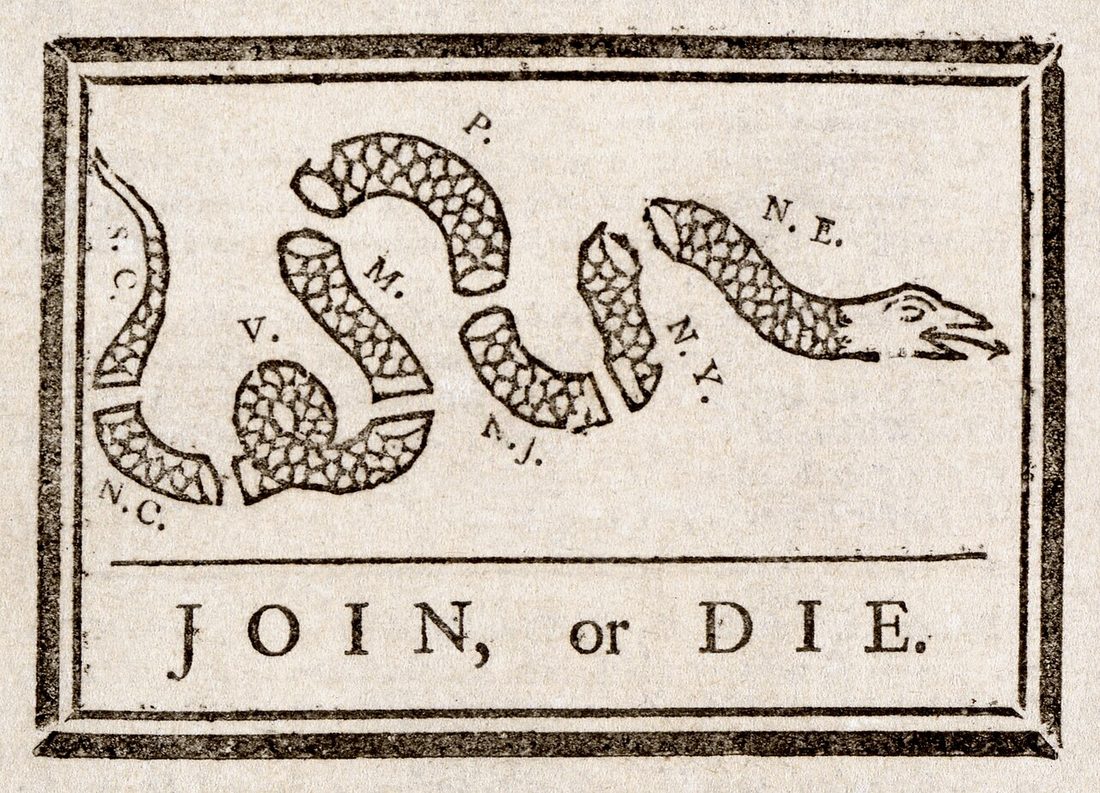
Auf Deutsch: Politische Cartoons beziehen sich auf ein konkretes Ereignis. Für die Analyse brauchst du deshalb oft Hintergrundwissen. In einer Klassenarbeit bekommst du dazu meist eine kurze Information, die du nutzen sollst.
Explanation
Background information
- In 1754, there were British colonies along the east coast of North America. Each colony had its own government.
- In the west and north, France had its own colonies. Britain and France were rivals, and the conflict that became the French and Indian War was beginning.
- Benjamin Franklin, a printer, writer and politician from Philadelphia, thought the British colonies were too divided to defend themselves. In 1754 he proposed a plan to unite them, the Albany Plan. It was not accepted.
- At that time, there was a popular superstition that a snake cut into pieces could come back to life if the pieces were put together before sunset.
Elements of the cartoon
| element | what you can see |
|---|---|
| picture | a snake cut into eight pieces |
| labels | the initials of colonies on each piece: N.E. (New England), N.Y. (New York), N.J. (New Jersey), P. (Pennsylvania), M. (Maryland), V. (Virginia), N.C. (North Carolina), S.C. (South Carolina) |
| caption | JOIN, or DIE. |
| style | a black-and-white woodcut, as printed in newspapers at the time |
How to analyse a political cartoon
- Describe what you see (as in lesson 2).
- Identify the people, places or events the cartoon refers to. Use the labels and the background information.
- Explain the symbols and other means.
- State the message and the target: Whom does the cartoonist want to convince, and of what?
Examples
Example 1: A model description
The political cartoon "Join, or Die" was published in The Pennsylvania Gazette on 9 May 1754 and is attributed to Benjamin Franklin. It deals with the disunity of the British colonies in North America.
The black-and-white woodcut shows a snake which has been cut into eight pieces. The head is on the right and points to the right, the tail is on the left. Each piece is labelled with letters that stand for one of the colonies, from "N.E." next to the head to "S.C." at the tail. Below the snake, the caption reads "JOIN, or DIE."
Notice that the description already uses the background knowledge to explain what the letters mean. That is fine, because it helps to identify what is shown. The interpretation of the snake comes in the analysis.
Example 2: A model analysis
Franklin uses the snake as a symbol of the British colonies in North America. The pieces of the snake stand for the separate colonies, and the labels make clear which colony each piece represents. The order of the pieces follows the geography of the coast, from New England in the north to South Carolina in the south.
The snake refers to a popular superstition of the time: a snake that has been cut into pieces could come back to life if the pieces were joined before sunset. Readers in 1754 knew this belief, so they understood the image at once.
The caption "JOIN, or DIE." is short and dramatic. It presents only two options and leaves no room for discussion. In this way it puts pressure on the readers.
The message of the cartoon is that the colonies have to unite. If they stay divided, they will not survive the conflict with France. Franklin wanted to convince colonists and their governments to support a union of the colonies.
Why the cartoon is still known today
The cartoon was printed again during the conflicts with Britain in the 1760s and 1770s. Then it became a symbol of colonial unity against British rule. This shows that a cartoon can get a new meaning in a new context.
Rule
Political cartoons: describe, identify people, places and events with the help of labels and background information, explain symbols and means, state the message and the target audience. Use background information, but make clear which ideas come from the cartoon.
Exercises
Grundlagen
- Answer the questions about cartoon 2. a) What animal does the cartoon show, and what has happened to it? b) What do the letters on the pieces stand for? c) What is the caption?
- Complete the sentences. a) The snake is a symbol of … b) The caption puts pressure on the readers because …
Weiter
- Explain in your own words why the superstition about snakes was important for the readers in 1754.
- Write the message of the cartoon in one sentence. Start with: The cartoonist wants to show that …
Knobeln
- The cartoon later became a symbol of unity against British rule. Explain how the same picture can have a different message in a different situation (3 or 4 sentences).
- Draw your own simple cartoon in the style of "Join, or Die" about a topic at your school (for example: a class that is divided before a sports competition). Write a caption and explain your symbol in two sentences.
Lösungen
- a) a snake, it has been cut into eight pieces b) the British colonies in North America (for example N.Y. = New York, P. = Pennsylvania) c) JOIN, or DIE.
- a) … the British colonies in North America. b) … it gives only two options, uniting or dying.
- For example: People believed that a snake cut into pieces could live again if the pieces were joined before sunset. So the readers understood that the colonies were in danger, but that there was still hope if they joined together quickly.
- The cartoonist wants to show that the British colonies in North America must unite, because they will not survive if they stay divided.
- For example: In 1754 the cartoon called for unity against the French. Later the colonists fought against Britain, and the same snake now stood for unity against British rule. The picture stayed the same, but the enemy changed. The message depends on the situation in which readers see the cartoon.
- Individual answers. Check: a clear symbol, a short caption, an explanation of the symbol.